Showing posts with label Art. Show all posts

Thursday, February 19, 2015

Kill The Wabbit!

The TV show Frasier and the filmmaker Atom Egoyan lead me to believe that tasteful and intelligent people are supposed to appreciate the art of opera. I always wondered if I was missing something because I just didn't get it. Like most of my generation much of my familiarity with opera comes from old Warner Brothers cartoons.


I've only been to see live opera a few times. On each of those occasions I happened to notice that Atom Egoyan the Canadian filmmaker was in attendance. I assume he must be at every high-brow cultural event in Toronto because I've also seen him at most of the live theatre shows I've been to. Given his creative output he's clearly a tasteful and intelligent man with whom I think I would have much in common. A love of opera wouldn't be one of those commonalities.

Last week I was invited to watch the opening night performance of Wagner's Die Walküre by The Canadian Opera Company. This iteration happened to be directed by that very same Atom Egoyan so I could not refuse the opportunity. I've seen many clips of opera on TV and I've often been impressed and moved but I've always had difficulty understanding how such an art form has survived and maintained such a level of respect. Is it an example of an emperor having no clothes? 

I went into the performance with an open and tolerant approach. I admit that I've always been known to value the intellectual over the emotional, Apollo over Dionysus, Spock over McCoy. With some effort of my own and through the influence of the women in my life I've made great strides in this regard. I no longer prejudicially consider the emotional to be a failing of the intellectual, a sort of desperate cognitive response to stimulus that cannot be encapsulated within a satisfying intellectual enframing. Having achieved such recent personal evolutions I've noticed that I now enjoy films that I used to consider maudlin and over the top (Carlito's Way popped for me on a recent re-viewing). Wagner seemed to be as overripe and sentimental as anything from Hollywood so I wondered if I might be able to see it now with fresh eyes.

We had excellent seats, a few rows behind the conductor's head, so I was able to see his flamboyant gesticulations and some of the movements of the musicians in the back row of the orchestra. The show started with the curtain down. I was immediately enthralled by the conductor's movements and quickly began to appreciate the music for what it was, a bold and aggressive sonic creation. I closed my eyes and let my synesthesia have its way, seeing the sounds represented by the colours and shapes that ran multi-dimensionally through my mind's eye. The music is pretty impressive. I get how people can find art in the music.

I opened my eyes to see that the curtain had risen and an unexpected set was in my view. An interesting array of beams, girders, and light standards running in jagged and jarring directions. This seemed apt for the music I was hearing. So far so good. Set design, lighting and direction can be sources of artful creation that enhance the music.


Then a few of the singers started belting out the impressive and expressive sounds that can surprisingly come from the modest primate body of a human. It's hard not to be moved by the masterful reflections of human emotions that ride on the waves of air as they move from the midsection of a diva to the ears, mind and body of the listener. So far so good. The singing can be home to art.

This opera is a product of mid-1800's Germany. It is temporally, culturally and linguistically foreign to me. It may as well be traditional Indonesian puppet theatre. I've come across some completely foreign cultural performances, whether they were from Asia or Africa or the Amazon, and I've freely given respect and admiration to such things for their tasteful or moving arrangement of sights and sounds. A Wagnerian opera was such a thing for me. I wasn't sure what they were doing or saying but I dug their talent and commitment. 

Here's where it takes a wrong turn. Opera performances have surtitles running above the stage so you can read the translations of what they are singing. Holy cow! That is some fucked up shit! The narrative contents are chock full of bizarre, misogynistic, incestuous nuttiness. One could perhaps chalk it up to cultural relativity given that it's even further alienated from my experience being based on old Norse mythology.

But it's more than that. One quickly realises that the heartfelt ecstatic singing coming from the diva is often just some dull expository dialogue. A good filmmaker like Egoyan knows how to show rather than tell. So-called high-brow culture is very good at that. This is often what keeps it from attaining mass appeal. Opera seems to be curiously opposite. Wagner's Die Walküre displays what may ungenerously be described as amateurish, on-the-nose storytelling that hits the viewer over the head with broad preposterous over-seriousness. It seems like the fruit of an over-excited 14 year-old virgin boy who spends far too much time playing myth-based role-playing games. The weakest part of the art is at the heart of this art. It's all beautifully composed and executed music, singing, direction and set design but it's all done in the service of a ridiculous and overwrought core of a narrative.


From what I can gather it would be best to watch and listen to a Wagner opera without paying any attention to what it's all about. Perhaps the tragedy of all of this is that Wagner didn't have a writing partner who could match his musical skills with his sorely lacking storytelling skills. I can put up with a lot of silliness and even ugliness in art if it is in the service of a profound message, idea or feeling. I admit it's very likely that I haven't put in enough effort to fully glean the valuable subtext of this work, but it shouldn't be this unnatural and distracting to do so. Perhaps Atom and I could have a drink and chat one day. I'm still hoping that I'm missing something. 

Tuesday, December 17, 2013

The Sweet Science

Boxing is a fascinating sport because it lives in a tension between being a primal contest of force and a highly elevated contest of technique and strategy. You can win by mastering either side of this tension but those who can master both have much in common with great artists.


I happened to tune into HBO Boxing this weekend. I didn't know anything about the scheduled bouts and started watching about a minute into the first round of the James Kirkland / Glen Tapia match. It was obviously a vicious fight, all about force and will. Both men absorbed as much punishment in the first few rounds as any boxer could expect in several fights. It brought the competition as close as possible to a fight to the death. One couldn't help but be affected by the fight, whether in disgust or admiration. 

The chatter in Kirkland's corner was especially revealing as his trainer Anne Wolf growled to him "you done took his nuts now you gotta take his heart", insisting that his opponent wanted to kill or humiliate him and that only destroying his opponent would win the day. That nearly became a self-fulfilling scenario because it seemed that both fighters were determined not to go down no matter how much punishment was to be absorbed. In situations like these boxers can and have died in the ring. It became clear that, unless outside forces intervened, these men would fight until one of them was unconscious or dead.

In a contest like this it ceases to be about boxing skills. Eventually it even ceases to be about strength and physical force. It becomes a contest of wills. After some back and forth Kirkland started getting the upper hand and was mercilessly beating Tapia against the ropes. The ring-side doctor had a look twice between rounds and declared that he was very close to calling the fight. They were allowed to continue. Eventually, and probably much later than was prudent, the referee intervened and stopped the fight. Just as he jumped in between the two fighters Kirkland continued with two final punches that actually seemed to knock Tapia out on his feet. He was held up by the referee to save him the embarrassment of being thrown unconscious to the canvas.

One couldn't help but be drawn in by the visceral drama of the fight even as it was accompanied by a tragic sadness and fear that someone might actually die unless the fight was stopped. In moments like this you get a glimpse of our indefatigable primitive selves. It's draining and exciting to watch such spectacles. At its heart boxing is a vicious competition to the death but it's contested within the bounds of a set of rules designed to leave in everything but the killing.


And just as I was coming to grips with what I had just experienced, the next bout swung everything back all the way to the other sweep of the pendulum. Guillermo Rigondeaux is a very experienced fighter out of Cuba. He is one of the most technically gifted boxers in the world but only turned professional recently after leaving Cuba for Miami. He has developed a style that makes it almost impossible for his opponents to hit him. His speed, strategy and anticipation allow him to cut in quickly, tag his opponents with a flurry of punches and then retreat before they know how to respond. His opponent Joseph Agbeko is known to be a very skilled fighter who throws a lot of punches in any given match. In this bout he was reduced to a confused mess of a fighter, unable to mount any offence. In some rounds he was unable to connect on any punches at all while many of the punches credited to him by the scorekeepers were charitable since they only barely touched Rigondeaux while lacking any force or harm.

It was a technical tour de force but what's really interesting is that many of the fans in the stands started filing out of the venue, considering the fight to be very boring. Most fans don't like this fighter nor his fights. There is little appreciation for his style and he cannot understand why that is, believing that it is a conspiracy and prejudice against Cuban fighters. The point of boxing is to hit your opponent while avoiding being hit and he does this as well as anyone has ever done. He's simply not appreciated for it by anyone other than a few hardcore boxing wonks.

Rigondeaux is unlikely to get very rich from professional boxing. The lesser technically talented Tapia, unless he's killed or maimed in the ring, is loved and may well go on to make a fortune by giving and receiving punishment. It's much easier to understand a beating than the chess match offered to fans by Rigondeaux.


There is a familiar diametrical opposition to the way viewers respond to various expressions of style in the arts. In the realms of music, painting, writing or film one finds similar disagreements about what is considered exciting and impressive; pop music vs jazz, Rockwell vs Rothko, Rowling vs Pynchon, Spielberg vs Kubrick. The opposition often tends to be between the emotional vs the intellectual. Pop/emotional styles are criticised for being too simple and primitive, while styles demonstrating advanced technique are criticised for being alienating and heartless.


Boxing as The Sweet Science reflects emotion in the sweetness and intellect in the science. It's inherently understood that greatness involves mastering both. A Nietzschean approach might be to discuss the interplay of The Dionysian and The Apollonian in the creative process. Creations that move us to strongly feel and simultaneously to think in challenging ways are often considered masterpieces. Muhammad Ali is a legendary hero and a Superman of the sport because of his mastery of both spirits. Artists of any medium who can demonstrate mastery of both sides of this coin can aspire to such heights.

Wednesday, February 04, 2009

Almost Free Gallery Space for Artists

I have a storefront on Dundas St. West Junction in Toronto that would be very well suited for an art space.

25 ft wide window exposure.
12 ft ceilings with abundant track lighting.
800 sq.ft. bare bones gallery
+ 2000 sq.ft unfinished basement
+ another 2000 sq. ft. finely finished space with up to 16 ft. ceilings for an opening party.

Here's what I suggest:

I would offer the space to an artist or collective of artists to use the space on a short term basis (nightly, weekly or monthly) to host art openings and/or to display their art for show or sale. I may ask only for works of art as payment in lieu of rent.

Let me know what you think and pass this on to whomever you think might be interested.

jake@jake2universe.com

Sunday, February 01, 2009

Wednesday, January 14, 2009

I Miss My Dog


Monday, January 12, 2009

Art and Mortality


Tuesday, December 30, 2008

Filler Blog Posting

This is the end of my third full year of blogging. During 2006 and 2007 I averaged about 1 blog posting every 3 days. In 2008 I averaged a miserable 1 posting every 13 days. I can't promise I'll post any more frequently next year to this blog but my creative output should increase through some other projects that are underway for the new year.

Film:
I'm working with director Andy Keen to produce and write a basketball-related feature length documentary film called DUNK! You might be hearing more about this as the project progresses. It is now in production and slated for completion in early 2010.

Visual Art:
I've teamed up with long-time friend Robert Anthony to produce a regular web comic strip that doesn't yet have a name. You will see the first of them in January 2009 and probably on a weekly basis thereafter.

Literary:
I plan on finishing one and possibly 2 novels during the next year. One novel is a sci-fi-psy-phi love story about a physicist while the other is written as a memoir/bio by a philosopher about his troubled childhood artist friend.

Music:
I've got nothing here besides a few Garage Band mixes that I've created on my iMac, but I would be willing to play drums with anyone who'd be interested in jamming.

Plus there's some talk of a podcast with a broadcaster friend of mine and also that screenplay that's been half finished for over 5 years.

If I blog one more filler posting before the year is over I could get my average up closer to once every 12 days.

Monday, August 25, 2008

Does This Image Make You Want To Rape?


I am a strong proponent of liberal expression even when it is somewhat offensive. At the same time I am sensitive to the issues surrounding the exploitation of women. American Apparel ads have served lately to cause a schism in liberal circles between those who would more value one consideration over the other.

When this ad appeared on a billboard in New York's lower east side someone eventually spray-painted it with the message "Gee, I wonder why women get raped?". I've seen the same ad on a billboard on Yonge Street in Toronto and I have to say that I didn't decide to rape anyone as a result of seeing it. Consider that this photo is a self-portrait taken by the Artist Kyung Chung. Her backside wrapped in tights is turned to the camera as she's slightly bent over. It is undoubtedly an erotically charged pose but I fail to see any exploitation. She is a strong women artist in a strongly sexual pose, completely in charge of the situation. There is no hint of compulsion within the narrative of the photo. The character is bent over suggestively and one of the reasons it is so alluring is that she is in charge of the situation and seems to be demanding the service of her imaginary lover. Chung's photo does not portray the female character to be vulnerable in any way in which she doesn't want to be.

People seem more sexually liberal in Europe where you're likely to see this kind of advertising but with even more nudity. In cultures where women are presented and represented in scant cladding we don't find them to be at higher risk of being sexually assaulted. I would argue exactly the opposite. Cultures wherein the revelation of skin is discouraged seem much more dangerous to women. If a women shows any flesh in Saudi Arabia she might be considered a slut and therefore much more likely to be raped than in Copenhagen where she can walk around (weather permitting) in next to nothing.

Someone is quoted in a newspaper article about Chung's photo saying "I don't think you need a PhD to recognize that ... [this] is nothing but an ad for - and I'll put this gently - anal intercourse," - What? First of all who would produce such an ad? Would it be presented by the AIAA (Anal Intercourse Association of America)? Secondly, why does penetration of one kind seem demeaning to her besides another kind. I think there are actually some people who enjoy such things and don't need to be forced to do it. Also she might want to note that that's not the the only kind of penetration possible in that position, but if your dirty mind causes you to leap to that scenario then you have to see that the model in the picture is demanding it not resisting it, so how does rape or a demeaning scenario even come into it?

What if instead of discouraging sexually suggestive ads we just didn't make such a big deal about them? Wouldn't women be safer in a society that viewed such images as commonplace? It seems to me that sexual repression is more likely to lead to desperate acts of violence against women than sexual liberation. I'm sure that the critics of these ads have nothing but the best of intentions to protect women from harm but that photo of Kyung Chung can also be seen simply as a beautiful and powerful image created by a beautiful and powerful women.

As a point for comparison the story being told in the D&G ad below seems to more clearly cross the line. The narrative within this vignette clearly suggests a gang rape scenario. Even though this ad is aimed at women and even though some women may have such fantasies I can see why it may be offensive.

Friday, September 14, 2007

Blogification

I've recently started watching a TV show called Californication. It's ostensibly about a writer going through a protracted period of writer's block accompanied by a similar obstruction in his personal growth. How apropos. David Duchovny of X-Files fame stars as Hank, a loveable self-destructive writer who has so fallen on hard times that he has been forced to take a job writing a regular blog, all this while trying to win his wife and daughter back.

The show is only so-so. Better than most things on TV but not as good as the best from HBO. What continues to grate on my nerves is that Hank constantly ridicules and derides blog writing as somehow meaningless and something of which any self-respecting writer would be embarrassed. It's true that blog writing is the only writing I've been able to finish on a semi-regular basis lately but this is not a self-defense response.

It should be admitted that most blogs are not written at the level or sophistication of most published novels, but some are. For every dozen mommy-bloggers who fill their pages with fastidiously chronicled minutia of every baby step and diaper change there's a Cognitive Daily For every hundred cat-bloggers who furnish us with their daily furry photos there's a Cosmic Variance. The point is that the choice of medium in which the writing is presented cannot determine the quality of the content. There are some horrifically bad books that sit on the shelves of your local bookstore just as there are some excellent poetry blogs online.

It's true that anyone can write a blog while you must be chosen to be published, so the odds are better that you'll find quality in one medium compared to another but the art is ultimately in the content. There is also a natural process of selection that begins to work when you link from blogs you like to other blogs that they like. Eventually you discover dozens of blogs that you might want to read on a regular basis.

Art can be found just about anywhere a producer chooses to put it. Film snobs like to brag that they don't own a TV as if shielding one's self from any medium could somehow be considered noble. Art can be found in any medium you choose to look at. It can be found in the content that is produced specifically for your TV, cellphone, flash player, sidewalk, milk carton, bus shelter or toilet stall. Snobbery directed prejudicially and wholesale against various media like TV, blogs or even comic books (the most artful of which are now called graphic novels) belies a misunderstanding of what and where art is.

Saturday, August 11, 2007

This Music is Gay!

Men in Istanbul walk hand in hand, kiss each other in greeting and occasionally lather each other in a Turkish bath, and those are just the straight men. Turkey has a very macho culture where so-called manliness is highly prized and praised. Every time I look up at a TV or glance at a tabloid here in Istanbul I seem to come across the face of a rather severe looking female singer by the name of Bulent Ersoy who it turns out was once a man.

People can't seem to get enough of her. She seems to be hosting a different show every night, her photos are on the front pages of most newspapers, people are talking about her plans to adopt children and about what her 23 year old husband was doing with another woman last week.

It seems very strange at first to find that they have elevated a transgender performer to the pinnacle of their entertainment pyramid, and it should be noted that this is not just a freak-show curiosity since most everyone really appreciates her singing talents and her bravery. There is a surprising readiness to accept LGBT people in the world of entertainment even if these people aren't readily accepted in the more mundane workplaces of the everyday world. As a very young child in Istanbul I remember asking my Mother why people said Zeki Muren was a man when he clearly looked, dressed and sang like a woman. Later when I moved to the West I confused him with Liberace who engendered the same question.

As a youth I remember watching Mick Jagger strut on stage like a preening girl more or less kissing Keith Richards while tough-guy biker-types in the crowd roared their approvals. As an aside, for years I confused Ron Wood with Rod Stewart (another male performer with clearly gay mannerisms). Freddie Mercury of Queen also strutted around on stage like a prima donna but by this time I had chalked it up to the understanding that British people were just more pimp and circumstance than the rest of us. It never really occurred to me that these people might be gay; It's just how rock stars behaved.

If you survey the pantheon of pop music you will find a very lengthy list of male rock stars who were either gay or behaved in a stereotypically gay manner on stage. They wore makeup, tight tight jeans, wiggled their asses and stroked their bodies like strippers. The hair bands of the 80's represented the extreme manifestations of this tendency.

During my teenage years it was so much fun watching Robert Smith of The Cure prance around in Love Cats that it almost made me want to wear mascara, hairspray and elaborate jewelry. The straight male population is accepting of this style even if most of them aren't accepting of gay culture in general but the female populace seems to simply adore it. Most heart-throbs marketed to little girls are soft smooth effeminate boys who are also highly attractive to the gay male population. It baffles straight men why women are more attracted to pretty-boys over manly men but the advent of the Metrosexual seems to be an effort to appeal to this tendency in women.

This is not new. Dionysus, the original rock star gave the women of Thebes ecstatic fits and the men were so drawn to the spectacle that they dressed up and joined the women in their adoration of Dionysus. The Dionysian is often aligned with the feminine spirit of humanity while the Apollonian is aligned with the masculine. Meaningful art results when both are twined in an interplay of the forces of human natures. Whether you are drawn to Apollo or Dionysus you cannot help but appreciate the art that results in their admixture and even the hardened men of a militaristic middle power like Turkey appreciate the beauty of art made by a creature borne of a mixed spirit. Rock stars as well as audiences seem to know this intuitively.

Wednesday, June 13, 2007

This Week in Authenticity

1. The Luminato Festival just wrapped up here in Toronto. It seemed to come out of nowhere to be something quite huge. I read a criticism of the festival in a major newspaper. The journalist wrote that the festival really wasn't authentic; that it seemed more an example of how a corporation would design an arts festival. He was of the opinion that Luminato was something that did not originate from natural artistic expression and was therefore inauthentic.

2. I heard an executive of the new Toronto FC soccer team describe how they wanted to create an authentic soccer experience for the fans of the new team. They decided to do this by copying most every obvious cultural marker of European soccer teams. The name, the uniform, the logo, as well as the songs that are song by the fans would all be quite at home in the English Premier League.

3. I heard a VJ say that the most important thing for young music fans is authenticity. She said that they can easily see through someone who is putting them on and only respect authentic artists.

4. I heard an advertising executive say that the most effective advertising is one that has an authentic message.

There is a lot of talk about authenticity lately. What does it all mean?

Thursday, January 18, 2007

Monday, July 03, 2006

Moire Patterns

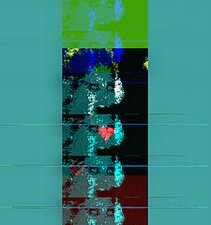
5 Video Stills rgb
These Five Video Stills (1990's) are some of the most accessible works created by Sternime after his resurfacing from the dark decade of the eighties. After creating such foreboding works as the Blackened Life series and photo essays like Grey Matter (1988), he turned to a more colorful approach and wholeheartedly began his study of popular culture, in particular the world of Advertising and Television. The perfect fusion of the heightened elements of these worlds is manifested in the Infomercial and an exploration of this is presented in I'll Cut Off Their Heads and Charge it To The Corporation (1990's)

When studied closely many of his photos appear to have moire patterns - the visual interference patterns that can appear if one takes a photo of a video image. They also frequently reveal pixelations. Occasionally he would glean a few images from hours of random television video recordings and then photograph them at precisely the chosen moment without pausing the image. But many of Sternime's photos were actually photos of a video screen displaying scenes that he had previously shot on traditional film. Having gone through these several transformations they begin to reveal some imperfections. These interference patterns are a welcome and intentional aspect of the final image presented by Sternime.

The scientific explanations for these patterns are clues to the role these interference patterns play in Sternime's study of popular TV culture. If one stands close to a television while it is displaying an image, one notices that the seemingly smooth contiguous images are in fact composed of a series of grid alternations of a few primary colours. The screen constantly refreshes itself several times per second. It does not do this all at once, but by alternating every other line across the screen, then it refreshes the missing lines right before beginning again. The human mind simply fills in the missing lines like it fills in the missing movements in a projected reel of film. The photo image sometimes catches it in the process of refreshing so that every alternating line is out of phase. Every alternating line is actually from the previous refresh wave right beside a line from the next refresh wave. The moire pattern is an interference of these lines.

What seemed poignant to Sternime was that "the interference results from the interaction of the past wave with the future wave and what we are left with is the present image - a clearly imperfect record of the marriage of what has already occurred to what has yet to happen."

This deconstructive view of a video image is richly filled with evocative symbolism. By bringing this process to light Sternime is playing with the notions of temporality, reality, appearance and memory. In its most basic definition, all art is merely some form of reflection. The manifestation of this reflection is also recorded in some physical form. It can be said that reality or truth is reflected in a work of art such that the truth of a peasant's life is in some respect reflected and recorded in Van Gogh's painting of a pair of torn and tattered slippers that have been flung upon the floor.

But what could be said to be reflected in a work of art that records examples of advertising? Sternime's answer is rich and layered. The first thing to consider is that Sternime's definition of art would be much more inclusive than one might find in any academic theory. For him, art can be present in just about any reflected medium. The ever-present media of Television can be home to art. This is not surprising. What is surprising is that the advertising commercials sandwiched within the shows can also be home to art.

Sternime makes no effort to present examples of art in advertising. What is revelatory for the viewer of Sternime's work is that by studying the processes of advertising one reveals a deeper understanding of the nature of art. For Sternime, Art and Advertising are both activities that seek to exploit a particular medium or media to invoke a powerful effect upon the viewer.

Nietzschean aesthetics speaks of forces of artistic nature that align themselves in an opposing duality. There is the orgiastic random passion of the Dionysian opposed to the organizing structured regularity of the Apollonian. A similar duality is explored in Sternime's own meditations on Art. He touches on the opposition of the individual with the collective and the varying perception and understanding of the same world when viewed at the micro or macro levels.

The question asked by Sternime is "what can we come to know of the whole by studying the parts, and what do we come to know about the part by studying its whole?" The locus of the experience of art begins with the reflected image, but the image exists as both an interesting physical process of perception and a more interesting mental process of appreciation. The experience of art begins with something that is perceived and something that is appreciated through that perception. In these Five Video Stills Sternime reminds us of the reflective nature of the perception.

... - to be continued.

Saturday, June 10, 2006

Thursday, June 08, 2006

Universal Standard

Posted by Picasa


In this peice entitled Universal Standard (1990's) Sternime plays with the stereotypes of what he called "the average nuclear family complete with all the toxic sludge one would expect".

Sternime had little opportunity to experience a childhood that could remotely be considered normal except for the brief span of a few months when his Mother Gloria moved in with a policeman and his daughter. This rigid and authoritarian man "was obsessed with all the outward appearances of normalcy, set up mainly as a subterfuge for his true psychopathic nature".

Later his mother would admit to him that this episode was her attempt to sacrifice her happiness so that little Sternime could "have a normal family setting within which he could hopefully become more normal". It turned out to be a horrible experience for both he and his Mother until the policeman died under suspicious circumstances while allegedly cleaning his gun.

Monster Devour

Posted by Picasa


From the Monster Series (1990's) another example where the filmic and the photographic were combined to create a gallery piece of strong kinetic intensity. In these works Sternime explores his almost pathological unease with sexuality. He claimed that the feelings associated with sex would nearly overcome him. He likened those emotions to "having feelings of motherly love and comfort suddenly torn asunder when your mother turns and decides to devour you whole". Sexuality for Sternime was a nexus of comfort, coersion, and cannabilism.

He admits to having watched several horror B-movies with his mother as a young child. Sternime's mother Gloria was an independant minded single mother who never married and had a series of men revolve through their lives. Little Sternime would often find himself at the drive-in movies with his Mother and her date. After being lovingly tucked in to sleep he would recall often waking during his sleep to the shrilling screems of the movie. He wasn't sure at the time whether he was dreaming but would be startled to find that in addition to seeing and hearing someone being hacked and slashed to death on screen he would peek open his eyes to see what appeared to be his mother "savagely and with hungry desire cannabalizing this poor man who was lying on his back and writhing in pain".

The stylized representation of the act of fellatio plays prominently in many of his films and display pieces. He considered it to be "at once the most giving and most debilitating act that one can perform on a lover. It is an association between two people that requires the greatest of intimacy because it prioritizes the the need for trust over and above the fear of being castrated". The fear of cannabilistic castration seems to have won out for Sternime since the fellators represented in his works tend more often to be depicted as monstrous.

Friday, June 02, 2006

Grey Matter


Although Sternime is best known for his films, he is regarded by many to be a photographer first. His cinematic shots were painstakingly researched and planned. Sternime insisted that each of his scenes could be frozen and be taken for photographs in their own right. While planning his shots for a film he would spend months taking photos and developing his visual ideas so that they could stand alone and be appreciated. These recently discovered stills taken by Sternime in the eighties reveal a darker tonality of subject matter. They were undoubtably taken with some cinematic idea in mind. Sadly, these were never developed into any film he made. So they stand soley as a photographic representation of a cinematic project that never occurred. Struggling through his depression and solitude he continued quietly to work through his personal troubles by externalizing what he called his "overbearing dark nothingness within the geography of my mind".

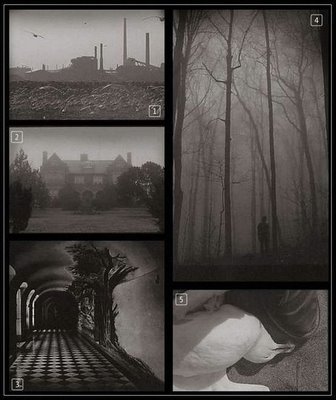
This series of photographs is titled Grey Matter (1988). They were titled and sub-titled by Sternime but were not numbered as they appear here. They were meant to coexist in a group but not within any order. As the name would suggest, they are meant to somehow externalize the psychic dread into the physical world. He invites the viewer to enter his mental blackened psychological realm. Sternime often struggles with the intertwining connections between the physcial and the psychical in his works. Fully aware of his embodied physical existence, Sternime commented "at this one level I know I am comprised of physical elements that determine 'how' I am. Yet I am also certain that 'how I am’ psychically determine my physical existence." Grey Matter is an apt title, referring to the physicality of the "stuff" or "matter" of the brain while also referring to the more abstract "greyness" of his emotional being, "the matter of greyness in my life"

Photo 4 (Amongst Tendrils). A powerful evocation of forlornness, it presents a young man visually overpowered by the complexity of a forest of "tendrils". He is lost within and overwhelmed by the barren dusky greyness of the steep forest of the visually interconnected branches.

Photo 1 (Innocent Beauty) reflects his early childhood memories growing up in an industrial town. Sternime had never been able to shake the effect of the industrial landscape on his imagination "beautiful and horrid in the same billowing plume". Industrial architecture conveyed to Sternime "a solidity of purpose, an economy of design that purely follows function without any need for artifice" The magnificent smokestacks seem to spew toxic smoke to some but soft puffy clouds to the mesmerized child. The innocent seagulls fly about in the foreground of the factory. The moniker of innocent beauty is perhaps more attributed to the factory than the birds. The factory is built with no regard for beauty yet to Sternime it is unconciously or innocently beautiful. The forlornness shown in # 4 is counterposed to the iconic representation of homecoming.

In photo 2 (Dwelling) an estate is enshrouded in a misty haze. It is an ideal home setting of a beautifully landscaped property. Despite such perfection, it is abundantly clear that little life is revealed in the shot. The imagery is more funereal than domestic. One’s lifelong homesickness can only be satisfied with the ultimate blackness of death. So it is here we see Sternime working out what was to become one of his cinematic motifs: that a constant estrangement with the everyday cannot ultimately result in any satisfaction.

In photo 5 (Grounded), a seagull is shown at the foot of the photographer. After a life of flight - a life of ethereal imagination - we are reminded that we will be grounded by the physicality of the everyday world. "After dancing with the stars, we fall back to the ground which is our dwelling".

Photo 3 (Corridors) once again returns to the internal tendrils of the imaginative experience. Black and white photography became much favoured by Sternime during the eighties. "Two colors in opposition, yet together they produce infinite shading." This perfectly symbolized the central opposition in human imagination for Sternime. Human experience is at once capable of the highest highs and the lowest lows. The checkerboard pattern of the floor as well as the alternating pillars revealing light and casting shadow are clues to Sternime’s revelation of this infinite opposition. Yet in the corridor of black and white there grows an organic branching of tendrils again defying the sterility and thriving in spite of the shade.

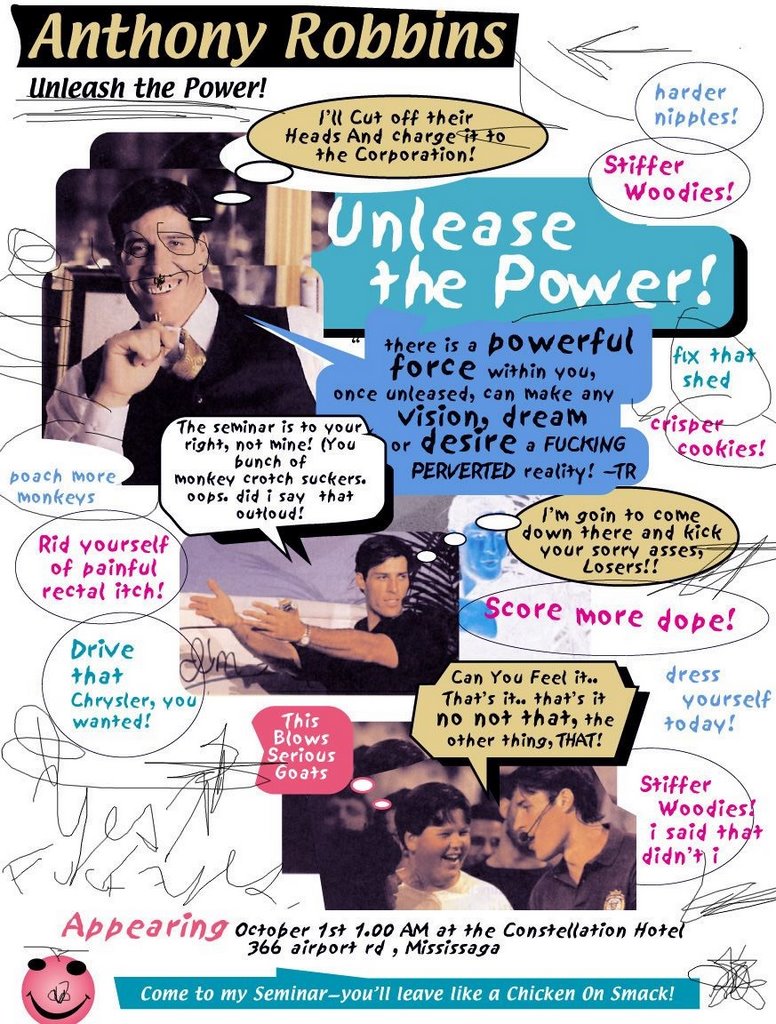
Empowerment


I'll Cut off their Heads and Charge it to the Corporation was a departure for Sternime. It appeared as part of the Schwarzes Leben series created in the early nineties. Despite his advanced middle age, he successfully transferred his angry detachment to the medium of visual arts. Having enjoyed a medial success in the art circuit cinemas of Europe and North America, he had sunk into a protracted depression and produced little in the eighties, often characterized by him as "my personal dark ages".

He sprang to the fore once again with his Blackened Life outpouring that garnered as much confusion as praise. Those familiar with Sternime's work quickly realized that there was much consistency of purpose in his newly chosen medium with his cinematic works. Sternime had become somehow more youthful in this example of externalized anger at those "who peddle self-induced spiritual lobotomy". He seems to poke fun at the entire culture of crass capitalism that had begun to pervade the seemingly unconnected realm of the religion. It occurred to Sternime that there had been a blurring of the realms of Capitalism and spiritualism. Tony Robbins merely served as a personification and an embodiment of this newfound "Salvation for Sale" that merely seemed to carry on the ancient strategy of charging a fee for enlightenment. These new cultural developments however were much more likely to succeed according to Sternime simply because religion finally fully appreciated and exploited the realm of advertising and promotion. As is the case with the world of advertising, much is highlighted and much is left out of the message.

These self-help strategies espoused by Robbins et al refer to "the power within" that needs to be unleashed (intentionally mis-spelled as "unleased"). It implies that the secret to success simply lies in unbridling those powers that surge within us. Sternime referred to this new spirituality as "a turning on its head of two thousand years of Christianity". It lays religion topsy-turvey because instead of encouraging the repression of "the power within" it encourages an unleashing. What is reprehensible to Sternime is that this strategy ignores the true force of this unleashing. It disregards that true self-awareness must involve a full acceptance and recognition of all the "leashed powers within us" including the unpleasant ones such as the need for domination, sexual savagery, and presence of overwhelming anxiety.

Millions of years of savage existence cannot be repressed that easily, especially after unleashing the powers within. We cannot simply choose to retain some of these leashed powers while picking over those unpleasant powers within. Learning about and addressing what you really want will inevitably make you dirty. As he said in an oracular manner in a 1981 interview, "When we stand too close to the fire of our desires, we are blackened by the soot of the ember of our ancestors"

Thursday, June 01, 2006

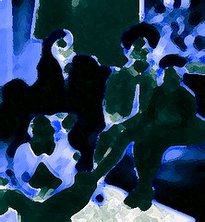
MWAA


In this memorable scene from Mother Was Always Angry (1972) Sternime uses an intense blue filter to coincide with Drago's barren maternal environment. A montage of images from his most distant memories, it displays a series of closeups of his mother and father from the vantage of a child looking up. The coloring of Drago's memory - now grown - reveals in retrospect that there was no love in his early life.