Showing posts with label Sternime. Show all posts

Monday, July 03, 2006

Moire Patterns

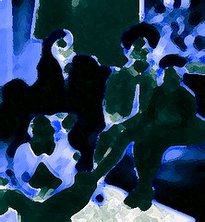
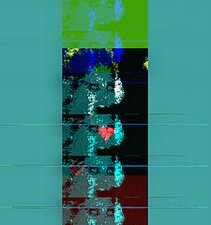
5 Video Stills rgb
These Five Video Stills (1990's) are some of the most accessible works created by Sternime after his resurfacing from the dark decade of the eighties. After creating such foreboding works as the Blackened Life series and photo essays like Grey Matter (1988), he turned to a more colorful approach and wholeheartedly began his study of popular culture, in particular the world of Advertising and Television. The perfect fusion of the heightened elements of these worlds is manifested in the Infomercial and an exploration of this is presented in I'll Cut Off Their Heads and Charge it To The Corporation (1990's)

When studied closely many of his photos appear to have moire patterns - the visual interference patterns that can appear if one takes a photo of a video image. They also frequently reveal pixelations. Occasionally he would glean a few images from hours of random television video recordings and then photograph them at precisely the chosen moment without pausing the image. But many of Sternime's photos were actually photos of a video screen displaying scenes that he had previously shot on traditional film. Having gone through these several transformations they begin to reveal some imperfections. These interference patterns are a welcome and intentional aspect of the final image presented by Sternime.

The scientific explanations for these patterns are clues to the role these interference patterns play in Sternime's study of popular TV culture. If one stands close to a television while it is displaying an image, one notices that the seemingly smooth contiguous images are in fact composed of a series of grid alternations of a few primary colours. The screen constantly refreshes itself several times per second. It does not do this all at once, but by alternating every other line across the screen, then it refreshes the missing lines right before beginning again. The human mind simply fills in the missing lines like it fills in the missing movements in a projected reel of film. The photo image sometimes catches it in the process of refreshing so that every alternating line is out of phase. Every alternating line is actually from the previous refresh wave right beside a line from the next refresh wave. The moire pattern is an interference of these lines.

What seemed poignant to Sternime was that "the interference results from the interaction of the past wave with the future wave and what we are left with is the present image - a clearly imperfect record of the marriage of what has already occurred to what has yet to happen."

This deconstructive view of a video image is richly filled with evocative symbolism. By bringing this process to light Sternime is playing with the notions of temporality, reality, appearance and memory. In its most basic definition, all art is merely some form of reflection. The manifestation of this reflection is also recorded in some physical form. It can be said that reality or truth is reflected in a work of art such that the truth of a peasant's life is in some respect reflected and recorded in Van Gogh's painting of a pair of torn and tattered slippers that have been flung upon the floor.

But what could be said to be reflected in a work of art that records examples of advertising? Sternime's answer is rich and layered. The first thing to consider is that Sternime's definition of art would be much more inclusive than one might find in any academic theory. For him, art can be present in just about any reflected medium. The ever-present media of Television can be home to art. This is not surprising. What is surprising is that the advertising commercials sandwiched within the shows can also be home to art.

Sternime makes no effort to present examples of art in advertising. What is revelatory for the viewer of Sternime's work is that by studying the processes of advertising one reveals a deeper understanding of the nature of art. For Sternime, Art and Advertising are both activities that seek to exploit a particular medium or media to invoke a powerful effect upon the viewer.

Nietzschean aesthetics speaks of forces of artistic nature that align themselves in an opposing duality. There is the orgiastic random passion of the Dionysian opposed to the organizing structured regularity of the Apollonian. A similar duality is explored in Sternime's own meditations on Art. He touches on the opposition of the individual with the collective and the varying perception and understanding of the same world when viewed at the micro or macro levels.

The question asked by Sternime is "what can we come to know of the whole by studying the parts, and what do we come to know about the part by studying its whole?" The locus of the experience of art begins with the reflected image, but the image exists as both an interesting physical process of perception and a more interesting mental process of appreciation. The experience of art begins with something that is perceived and something that is appreciated through that perception. In these Five Video Stills Sternime reminds us of the reflective nature of the perception.

... - to be continued.

Saturday, June 10, 2006

Thursday, June 08, 2006

Universal Standard

Posted by Picasa


In this peice entitled Universal Standard (1990's) Sternime plays with the stereotypes of what he called "the average nuclear family complete with all the toxic sludge one would expect".

Sternime had little opportunity to experience a childhood that could remotely be considered normal except for the brief span of a few months when his Mother Gloria moved in with a policeman and his daughter. This rigid and authoritarian man "was obsessed with all the outward appearances of normalcy, set up mainly as a subterfuge for his true psychopathic nature".

Later his mother would admit to him that this episode was her attempt to sacrifice her happiness so that little Sternime could "have a normal family setting within which he could hopefully become more normal". It turned out to be a horrible experience for both he and his Mother until the policeman died under suspicious circumstances while allegedly cleaning his gun.

Monster Devour

Posted by Picasa


From the Monster Series (1990's) another example where the filmic and the photographic were combined to create a gallery piece of strong kinetic intensity. In these works Sternime explores his almost pathological unease with sexuality. He claimed that the feelings associated with sex would nearly overcome him. He likened those emotions to "having feelings of motherly love and comfort suddenly torn asunder when your mother turns and decides to devour you whole". Sexuality for Sternime was a nexus of comfort, coersion, and cannabilism.

He admits to having watched several horror B-movies with his mother as a young child. Sternime's mother Gloria was an independant minded single mother who never married and had a series of men revolve through their lives. Little Sternime would often find himself at the drive-in movies with his Mother and her date. After being lovingly tucked in to sleep he would recall often waking during his sleep to the shrilling screems of the movie. He wasn't sure at the time whether he was dreaming but would be startled to find that in addition to seeing and hearing someone being hacked and slashed to death on screen he would peek open his eyes to see what appeared to be his mother "savagely and with hungry desire cannabalizing this poor man who was lying on his back and writhing in pain".

The stylized representation of the act of fellatio plays prominently in many of his films and display pieces. He considered it to be "at once the most giving and most debilitating act that one can perform on a lover. It is an association between two people that requires the greatest of intimacy because it prioritizes the the need for trust over and above the fear of being castrated". The fear of cannabilistic castration seems to have won out for Sternime since the fellators represented in his works tend more often to be depicted as monstrous.

Friday, June 02, 2006

Grey Matter


Although Sternime is best known for his films, he is regarded by many to be a photographer first. His cinematic shots were painstakingly researched and planned. Sternime insisted that each of his scenes could be frozen and be taken for photographs in their own right. While planning his shots for a film he would spend months taking photos and developing his visual ideas so that they could stand alone and be appreciated. These recently discovered stills taken by Sternime in the eighties reveal a darker tonality of subject matter. They were undoubtably taken with some cinematic idea in mind. Sadly, these were never developed into any film he made. So they stand soley as a photographic representation of a cinematic project that never occurred. Struggling through his depression and solitude he continued quietly to work through his personal troubles by externalizing what he called his "overbearing dark nothingness within the geography of my mind".

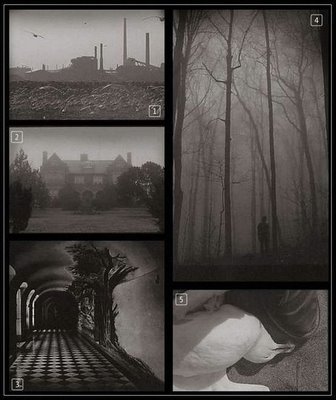
This series of photographs is titled Grey Matter (1988). They were titled and sub-titled by Sternime but were not numbered as they appear here. They were meant to coexist in a group but not within any order. As the name would suggest, they are meant to somehow externalize the psychic dread into the physical world. He invites the viewer to enter his mental blackened psychological realm. Sternime often struggles with the intertwining connections between the physcial and the psychical in his works. Fully aware of his embodied physical existence, Sternime commented "at this one level I know I am comprised of physical elements that determine 'how' I am. Yet I am also certain that 'how I am’ psychically determine my physical existence." Grey Matter is an apt title, referring to the physicality of the "stuff" or "matter" of the brain while also referring to the more abstract "greyness" of his emotional being, "the matter of greyness in my life"

Photo 4 (Amongst Tendrils). A powerful evocation of forlornness, it presents a young man visually overpowered by the complexity of a forest of "tendrils". He is lost within and overwhelmed by the barren dusky greyness of the steep forest of the visually interconnected branches.

Photo 1 (Innocent Beauty) reflects his early childhood memories growing up in an industrial town. Sternime had never been able to shake the effect of the industrial landscape on his imagination "beautiful and horrid in the same billowing plume". Industrial architecture conveyed to Sternime "a solidity of purpose, an economy of design that purely follows function without any need for artifice" The magnificent smokestacks seem to spew toxic smoke to some but soft puffy clouds to the mesmerized child. The innocent seagulls fly about in the foreground of the factory. The moniker of innocent beauty is perhaps more attributed to the factory than the birds. The factory is built with no regard for beauty yet to Sternime it is unconciously or innocently beautiful. The forlornness shown in # 4 is counterposed to the iconic representation of homecoming.

In photo 2 (Dwelling) an estate is enshrouded in a misty haze. It is an ideal home setting of a beautifully landscaped property. Despite such perfection, it is abundantly clear that little life is revealed in the shot. The imagery is more funereal than domestic. One’s lifelong homesickness can only be satisfied with the ultimate blackness of death. So it is here we see Sternime working out what was to become one of his cinematic motifs: that a constant estrangement with the everyday cannot ultimately result in any satisfaction.

In photo 5 (Grounded), a seagull is shown at the foot of the photographer. After a life of flight - a life of ethereal imagination - we are reminded that we will be grounded by the physicality of the everyday world. "After dancing with the stars, we fall back to the ground which is our dwelling".

Photo 3 (Corridors) once again returns to the internal tendrils of the imaginative experience. Black and white photography became much favoured by Sternime during the eighties. "Two colors in opposition, yet together they produce infinite shading." This perfectly symbolized the central opposition in human imagination for Sternime. Human experience is at once capable of the highest highs and the lowest lows. The checkerboard pattern of the floor as well as the alternating pillars revealing light and casting shadow are clues to Sternime’s revelation of this infinite opposition. Yet in the corridor of black and white there grows an organic branching of tendrils again defying the sterility and thriving in spite of the shade.

Empowerment


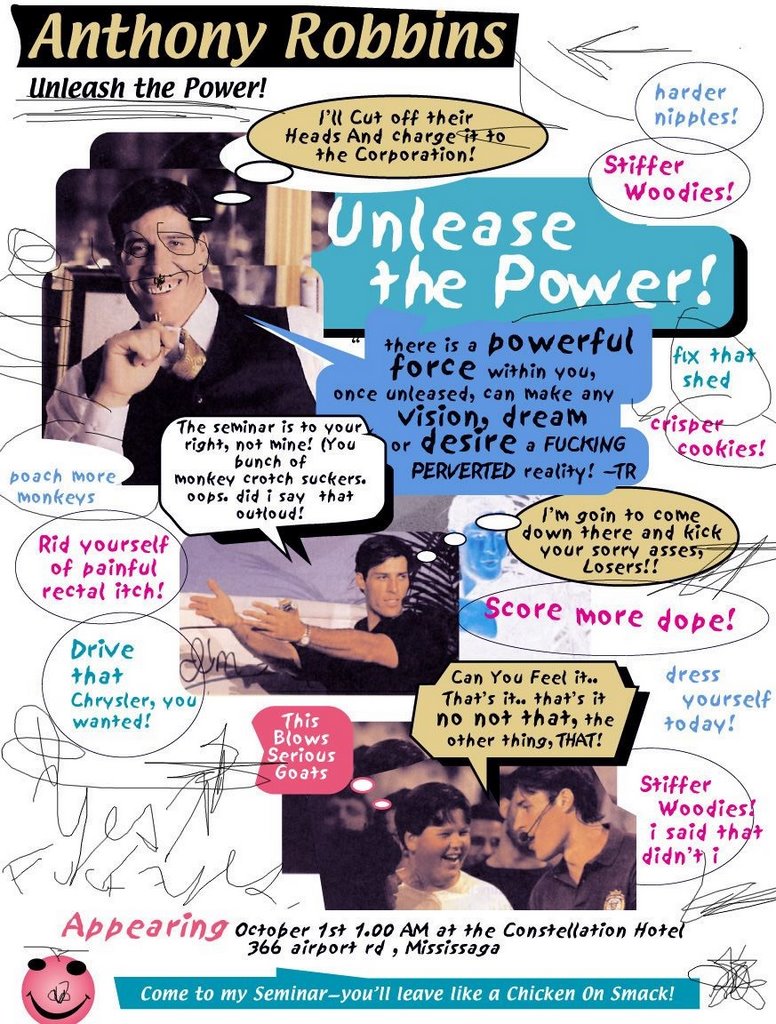
I'll Cut off their Heads and Charge it to the Corporation was a departure for Sternime. It appeared as part of the Schwarzes Leben series created in the early nineties. Despite his advanced middle age, he successfully transferred his angry detachment to the medium of visual arts. Having enjoyed a medial success in the art circuit cinemas of Europe and North America, he had sunk into a protracted depression and produced little in the eighties, often characterized by him as "my personal dark ages".

He sprang to the fore once again with his Blackened Life outpouring that garnered as much confusion as praise. Those familiar with Sternime's work quickly realized that there was much consistency of purpose in his newly chosen medium with his cinematic works. Sternime had become somehow more youthful in this example of externalized anger at those "who peddle self-induced spiritual lobotomy". He seems to poke fun at the entire culture of crass capitalism that had begun to pervade the seemingly unconnected realm of the religion. It occurred to Sternime that there had been a blurring of the realms of Capitalism and spiritualism. Tony Robbins merely served as a personification and an embodiment of this newfound "Salvation for Sale" that merely seemed to carry on the ancient strategy of charging a fee for enlightenment. These new cultural developments however were much more likely to succeed according to Sternime simply because religion finally fully appreciated and exploited the realm of advertising and promotion. As is the case with the world of advertising, much is highlighted and much is left out of the message.

These self-help strategies espoused by Robbins et al refer to "the power within" that needs to be unleashed (intentionally mis-spelled as "unleased"). It implies that the secret to success simply lies in unbridling those powers that surge within us. Sternime referred to this new spirituality as "a turning on its head of two thousand years of Christianity". It lays religion topsy-turvey because instead of encouraging the repression of "the power within" it encourages an unleashing. What is reprehensible to Sternime is that this strategy ignores the true force of this unleashing. It disregards that true self-awareness must involve a full acceptance and recognition of all the "leashed powers within us" including the unpleasant ones such as the need for domination, sexual savagery, and presence of overwhelming anxiety.

Millions of years of savage existence cannot be repressed that easily, especially after unleashing the powers within. We cannot simply choose to retain some of these leashed powers while picking over those unpleasant powers within. Learning about and addressing what you really want will inevitably make you dirty. As he said in an oracular manner in a 1981 interview, "When we stand too close to the fire of our desires, we are blackened by the soot of the ember of our ancestors"

Thursday, June 01, 2006

MWAA


In this memorable scene from Mother Was Always Angry (1972) Sternime uses an intense blue filter to coincide with Drago's barren maternal environment. A montage of images from his most distant memories, it displays a series of closeups of his mother and father from the vantage of a child looking up. The coloring of Drago's memory - now grown - reveals in retrospect that there was no love in his early life.